My last post was all a bit doom and gloom, wasn’t it? Not even any pictures. Sorry about that.
It spent a long time in the drafts folder, to be fair – a long time waiting for me to tie all the strands together, even though it did turn out to be like a loosely made pom pom: one weak central point and fluff scattered everywhere. But as I mentioned, it wasn’t easy to write. Time to look forward.
This one should be easier for both you and me – as I type I’m at the end of a week off from work with no particular agenda other than to rest, write and run. It came about after a gentle but firm reminder from HR to everyone who had ten or more days of annual leave: take it or lose it. As odd as it sounds taking holiday right after Christmas, the festive season isn’t exactly restful or relaxing and the first two weeks of January turned out not to be that busy, so it made perfect sense to take the time off. Andy’s already used his holiday days waiting for Thames Water to fix our sewer and we’ve neither the money nor the inclination to go abroad, so I treated myself to a staycation on my own. A whole week of wearing yoga pants and not talking to people.
The plan – because even on my day off there’s always a plan – was to use the mornings for running and the afternoons for writing and life admin; the longer game was to try and reset my routine altogether, hopefully making a few good habits that I could carry forward. Although a bit of rest (otherwise known as binge watching Fortitude on the sofa) would also be key, there wouldn’t be much point in getting used to a life of leisure only to suffer a massive culture shock on Monday. I didn’t just want to recuperate, I wanted a fresh start for a fresh new year.
So after moaning for eighteen solid months about never having time, what exactly have I been doing with my precious time off?
Running
Obviously. Getting into a training pattern of any kind is often an exercise in creating a good habit more than it is about the training itself. In my experience, a good habit can help in two key ways: normalising an activity, making its absence more notable than its presence, removes the conscious decision whether or not to do something out of my comfort zone and the risk that I’ll avoid it; and establishing a routine provides a reassuring constant which strengthens my defence against anxiety and doubt. It’s not just helpful for those who suffer with anxiety though; a good habit is crucial for succeeding at any new challenge. When it’s a one off, or if it doesn’t have a place in your schedule, there’ll always be more reasons not to do a new activity than there will be to go for it. It’s sort of why I get so into streaks, I suppose. And, to me at least, there’s something very comforting about having milestones to look out for in my day.
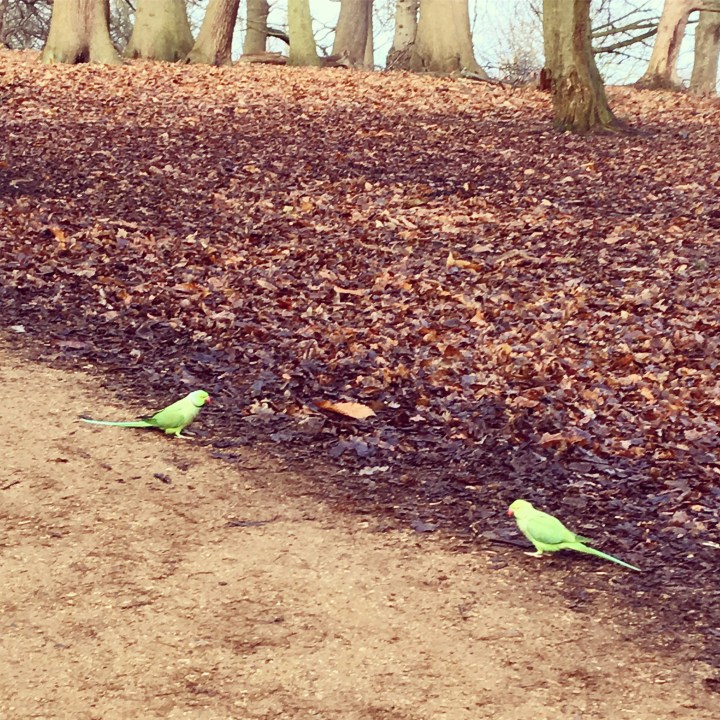
This week’s target on my training plan is 42 miles, mostly at a general aerobic effort or recovery pace, meaning that my effort shouldn’t ever really exceed the ability to hold a conversation. I’m used to that being somewhere in the 8:30 – 9:30 minute mile bracket but my fitness and my health are so far below where they used to be I’m barely going faster than 10:00mm, even when I bust a gut. It’s a fairly depressing place to start, but the only way to improve it is to persevere. So I found a neat little way to fit the miles in without doing circles around my house all the time; driving Andy to work and following up with a run around Richmond Park, with the added bonus of parakeets to play with. It’s been slow, but utterly joyful.

Word of the day, biophilia, has often popped up in my discussions with trail runners about motivation: a hypothesis that being surrounded by nature and living systems can help reduce stress and promote well-being. Spending time in woodland and on open hills, soft ground underfoot and fresh air in my lungs, never fails to improve my state of mind. And another effect of going off-road is a drastic reduction in the perception of effort; I can tootle along the North Downs Way for hours and barely feel it. But when I haven’t got time to play tombola with the Southern trains timetable (“Will the 8:30 to Epsom Downs turn up? Roll the barrel and take your chances!”) there are still plenty of green spaces for me to explore in the city within reach of a tube or my bike: besides Richmond Park, Wimbledon, Tooting and Clapham Common are all regular haunts, as is the Vanguard Way.
Having done my run I’ve been getting back home mid morning full of pep, usually around the time I’d be getting into a meeting if I was at work and resigning myself to no achievements. That pep has been put to good use giving the house a bit of a spruce – cleaning is loads easier when you don’t leave it for weeks at a time – which means a much nicer space to work in. Having done that I’ve been trying to get in at least 20 or 30 minutes of yoga, again something I’ve neglected horribly. Once I’ve unfolded myself out of “corkscrew” and popped my joints back in place the rest of the morning is reserved for correspondence (that sounds more romantic and Jane Austen-y than “checking emails”) or any other odd errands.
Resting
There needs to be some rest in there, I am a lady of leisure after all. I got through both series of Fortitude in four days – now of course anxiety dreams are replaced by nightmares about rabid polar bears – while balancing lunch on my belly. It’s Friday as I write this, and time for a change of mood, so I’m watching Dinnerladies from the start. I don’t think it’s possible to overstate how brilliant Dinnerladies was. I don’t think it’s possible to overstate how brilliant Victoria Wood was. Victoria Wood taught me about humanity and about comedy, which are always the same thing, and had a massive influence on my sense of humour (when I have one). It seems appropriate to take inspiration from her when retraining myself to be human.
Writing
Then from three o’clock onwards I’ve been taking my laptop and a cup of coffee down to the summer house to write. I was lucky enough to get on the shortlist of Penguin’s WriteNow project, a scheme offering mentorship to unpublished authors from under-represented backgrounds, but my third of a novel with no discernible narrative written in a tense that made the editor wince didn’t make the final ten, surprisingly. However the WriteNow team gave us so much valuable support and advice that I’ve decided to finish the damn thing and try my luck the old fashioned way. I’m still not changing the tense though.

The novel is a folly for which the optimistically named “summer house” is a perfect setting. The summer house is really just a cabin at the bottom of the garden which seemed to have been used for storing catkins and spiderwebs when we first moved in, but we’ve since furnished it as a bedsit for when my brother stays and now it’s basically the biggest and nicest room in the house. My aim was to try and get around 1000 words down a day, and the cabin is just far enough away from the house that the wi-fi is useless without a booster, which is handy for avoiding distractions. With the help of a new carpet and insulation, an electric heater and a hand knitted draught excluder, it’s actually super cosy down there now. In fact it’s almost as well equipped as Roald Dahl’s hut – all I’m missing is the Thermos flask. I manage a couple of hours without fresh coffee then it’s suppertime.
Recharging
As we do every January Andy and I have committed to cut down on stodge and make healthier suppers – not that we’re ready meal addicts, but anything requiring more imagination than a diced onion doesn’t get a look in on worknights. Since I’ve been home this week we’ve treated ourselves to square meals that have multiple vegetables and more than one colour in them, and again I find myself surprised (perhaps naively) at the effect proper food can have on mood. I know it’s pretty obvious, but it’s hard to be hangry when you’ve had your five a day. As with all these good habits, it tends to feed itself – you just have to get going in the first place. Or rather, you have to want to get it going. That, I think, is the biggest shift for me – after just one week of R&R I’ve started to care enough about my body to want to feed it decent things, not just to pay lip service to better living.
So I have to admit our HR department were on to something by insisting that people actually take their annual leave. This is usually where someone throws around the term “work-life balance” but as someone whose work patterns have traditionally been of the feast or famine model I’ve never been able to define what that means at all, let alone for me. Now I know what it doesn’t mean: pushing through fourteen months without a proper break, piling exhaustion upon sleep deficit, burning out and going mad. All feast and no famine. I could keep up that kind of pressure in my previous job because I knew there would be fallow months, but it’s taken me some time to adjust to this new, consistently busy schedule, one which requires me to take responsibility for my own health and rest even when we’re busy. It’s going to take time for me not to feel guilty about that.
Although I can’t keep up this lady of leisure act beyond Sunday it’s been just enough to taste what a properly structured life could look like. Work shouldn’t stop me from fitting in an hour of running and an hour of writing a day, or allow for the occasional lazy evening doing nothing of worth except rest – and to be fair it doesn’t, I do. In exposing myself to a routine I’d like to live by, in defining that for myself, I’ve given myself something to look forward to. I haven’t looked forward to anything for over a year now – I’ve been too tired to appreciate it or too afraid of making myself that vulnerable.
If you find yourself in this position, try to find time to take stock – OK you might not have a whole week going spare, but even one day or an hour every morning for a week is better than putting off your recovery over and over until it’s too late. It’s a bit like cleaning your house: if you do twenty minutes every day nothing gets too far out of hand. If you ignore it for months, you’re eventually going to have to call in the professionals.
I’m going to talk about mental health. It’s not an easy thing to talk about; partly because of the stigma, although that tide is on the way out. Mostly because, for many people, it can be hard to define. Good or bad, mental health is a vague, shapeless thing, often recognisable only in the negative spaces. I think you know when something’s wrong but do you know when something’s right? Do you know how to articulate what’s wrong?
I found myself in this position recently, having finally decided to talk to our company’s welfare counsellor. It took a while to build up the courage and make the appointment – what finally made the decision for me was the need to do something about my mental health not for me, but for the effect it is having on my partner and my friends. I can be as self-indulgent and -destructive as I please, but I have no right to take anyone else down with me. So she asked me what I wanted to talk about, and I said that I was struggling. I couldn’t think of another, less euphemistic way to describe it than that. Just that I was struggling, and I knew that the way I respond to things wasn’t normal, and I needed to do something about it.
I described being so stressed that I vacillated between insomnia and fatigue; actually, tiredness so profound it was paralysing. I described getting home from work one day and slumping to the floor in front of the sofa, unable to get up on to it to be more comfortable, unable to move at all, frozen there until Andy came home an hour later and helped me up. I described being in chronic pain quite a lot of the time for no specific reason and in no specific area, alleviated only by a good long run. I said that I suffered panic attacks. She stopped me there.
“What do you mean by panic attacks?”
As soon as I said it I realised it was a daft thing to say. I had grasped for a phrase to explain what I normally – again, euphemistically – call ‘episodes’, where terror grips my heart for no apparent reason and I burst into hysterics, hyperventilate, become numb, become paralysed, all at once. But of course it’s not panic and it isn’t an attack. I hate that phrase anyway – it infers that a panic attack is something that happens to you: a passive activity thrust upon you, an external influence. It isn’t, of course. It comes from within, it is created in my head and there is an unconscious decision to unleash it. It is, perhaps more appropriately, a stress response, and I am – to some extent – responsible for it.
If what I’ve described there is the tip of the dagger, then what comes next is the wound, which bleeds out if left unchecked. The emotional effort of an “episode” has a very physiological effect on me, quite similar to the effort of a marathon but without the endorphins. Or the sense of achievement. Or the permission to eat tons of cake. The most noticeable effect is that it wears me out, which is probably my body forcing me to rest by simply rendering me immobile for a day or two, but the flipside is that if I have to stay awake for any reason (you know, like gainful employment) I end up behaving like an overtired toddler at a New Year’s Eve party. Only now am I waking up naturally after less than ten hours of sleep; for the best part of 2017 I’ve been going to bed before half 8 (when I am able), and either being wrenched awake at half 7 the following morning feeling like the living dead, or staying awake until the small hours panicking about utter bollocks and seeing a liquid three hours of tearful, fearful sleep. I don’t think either of those make me a fun person to work with.
In fact I have a little sleep app which I set when I go to bed, which measures REM cycles and quality of sleep and on which I record notes relating to my day, such as whether I drank tea, coffee or alcohol, whether I worked out, whether it was a stressful day. Using that information it can tell me how those parameters affect my sleeping habits; it is not surprising that a stressful day generally correlates with poor quality sleep but working out and a solid 8 hours tends to give a higher score. It did, however, turn out to be a surprise one day when I noticed that for the first time since starting to use the app regularly I didn’t tick the box for “drank coffee”. I went one day without coffee. In over two years. Which makes the coffee parameter somewhat irrelevant and the whole enterprise less than scientific.
I say “less than scientific”: it’s just an iPhone app, a product designed to meet the current trend for simulated empiricism (among other things), so that people have the illusion of control over their lives because a fitness or lifestyle or health app is helping them track their every move. Scientifically speaking this kind of data analysis is at best valueless and irrelevant; or at least, it’s about as relevant as those Facebook quizzes that list your character attributes (they’re never really negative are they?) based on the third letter of your name or the date you were born. My point is that this very unscientific thing, this cynical tool of consumerist juzsh, has become a crutch in my daily life simply because I’m afraid of losing control, and this app makes me feel as though I have it. Copy and paste for MyFitnessPal.
Which brings me to what I believe is the contributing factor to these episodes: a fear of loss of control. My family, god love them, will tell you this is nothing new; I’ve been called a control freak many times before and not usually in the context of a compliment. The mistake I think they make – perhaps I should stop putting words in their mouths if I don’t want to be called a control freak – is that they think what I desire is control over everything, when in truth all I need is control over a fraction of myself. Control over everything? I’m not that ambitious. And I don’t like other people enough to care about controlling them. I just want to feel the tips of my own fingers.
Because that’s literally where every episode takes me. To the feeling that every molecule in my body becomes loose and starts to float away, that the bonds between them disintegrate and I become nothing. This is a waking nightmare I have suffered almost all my life, or at least since I was about ten years old; it’s also a recurring dream that plagues the few hours I do sleep at the height of my anxiety episodes. It can approach by degrees, perhaps at a professional or social occasion that I’m not entirely comfortable with, where I try to hold back the tide of anxiety for as long as possible and jump on a train home when I’m about to succumb; or it can hit me like a tsunami, where I’m coping one minute and the next I’m dissociating first from my surroundings, then from my peripheral senses, almost from my sense of self altogether: stranded. When I talk about losing control, I’m not talking about frustration that other people won’t bend to my will. I’m literally talking about losing the link between my physical body and my sense of self.
At one point or another this has manifested itself in the form of both claustrophobia and agoraphobia (it’s possible, look it up), as an eating disorder, as compulsions, and not at all. The common factor to all these self-prescribed treatments is the same thing: a misguided belief that activity X equals outcome Y, and I will regain control of all my molecules. But that fear of disintegration still tortures me. If I stand on a bridge I panic that my belongings will jump out of my pockets into the water, or that I’ll fall in even if I’m nowhere near the edge. If I drop something on the floor, I briefly imagine that it will fall into a black hole and be gone forever. If I stand still for long enough, I feel as though I will turn to dust.
This is what I wanted to tell the counsellor, and didn’t. I said a lot of things but I couldn’t articulate this. Six months on, and only now have I got the building blocks of the language I need to describe it to you – even then these words are to actual building blocks what Lego is to bricks and mortar.
It was far from a waste of time though – those two short sessions were enough to start the process of recovery, even if all they did was make me confront and find a way to define the immediate problem. We discussed the importance of running to my mental health, acknowledging that that one very simple treatment has never failed to alleviate my symptoms and working out how to make the most of it. I half expected her to tell me that actually there is no provable link between exercise and good mental health and that it’s all a placebo sold by Runner’s World – but then I thought, what does it matter if it is? As long as it works, and the worst side effects are boring your friends and never having clean hair, then I’ll take a placebo over losing hope that I’ll ever feel human again. It’s either that or knitting.
To anyone reading this who can relate to what I’ve written, or who recognises even a scrap of themselves in the chaotic fragments of my story, I say this: I know how lucky I am to have this resource available, and how stupid I am for not taking advantage of it sooner. Many people don’t have the luxury of a welfare counsellor at work or even know if they come on the NHS. If you have such a resource, use it. Not because a counsellor will fix you like a plaster on a papercut, but because they will start to teach you how to heal yourself. They might sow the seeds of recovery, or show you how to sow the seeds, or they might even start by explaining to you what seeds are.
If you don’t have access to a counsellor directly, be reassured that help is closer than you think. The Mind website is a great source of information on mental health, as are SANE and Rethink. And be reassured that mental ill-health is commoner than you think too, especially in this age of enlightenment. With the privilege of more and more instant access information comes the responsibility to evaluate it all, at an increasingly faster pace and with less and less tolerance for error. It’s like working on a factory assembly line, where the machine churns out parts at the same pace for years and years, and all the line workers have to do is put them together. Suddenly one day the machine doubles in speed and your boss docks your pay for every incorrect assembly. The effort of trying to keep up compounded by the fear of failure is a disaster waiting to happen, and yet we have to treat this situation as if it’s perfectly normal. Eventually, it is normal. But normal still isn’t the same as right.
If me and my molecules have been of any help to you then maybe it’s a step towards us all keeping up with the machine. And if they haven’t, then please know that you’ve been invaluable to me.
It’s my favourite event of the year. Well, no – Eurovision is my favourite of all events, but Druids is top as far as races go. It’s not even the running bit that makes it, although the Ridgeway trail traces my heart like my own veins; it’s the camping overnight in school halls, eating Anna’s mum’s homemade cake, drinking endless cups of instant coffee and sleeping on an army cot in the frozen depths of November that I can’t wait for. File it in the Venn diagram of “things that make me feel like a kid”/”things only trail runners do”/”happy things”.
I ran it in 2015 and 2016, but had to hold off this year due to the fourth Centurion Grand Slam, the Wendover Woods 50, being only two weeks later. Honestly I’m not sure what upset me more: missing Druids or missing out on the suicide challenge of doing both, just for lols. Nonetheless, paranoid that the slightest intervention would scupper my chances of finishing the grand slam (spoiler alert) I opted to wrap myself in cotton wool, and just volunteer instead. Easy peasy.
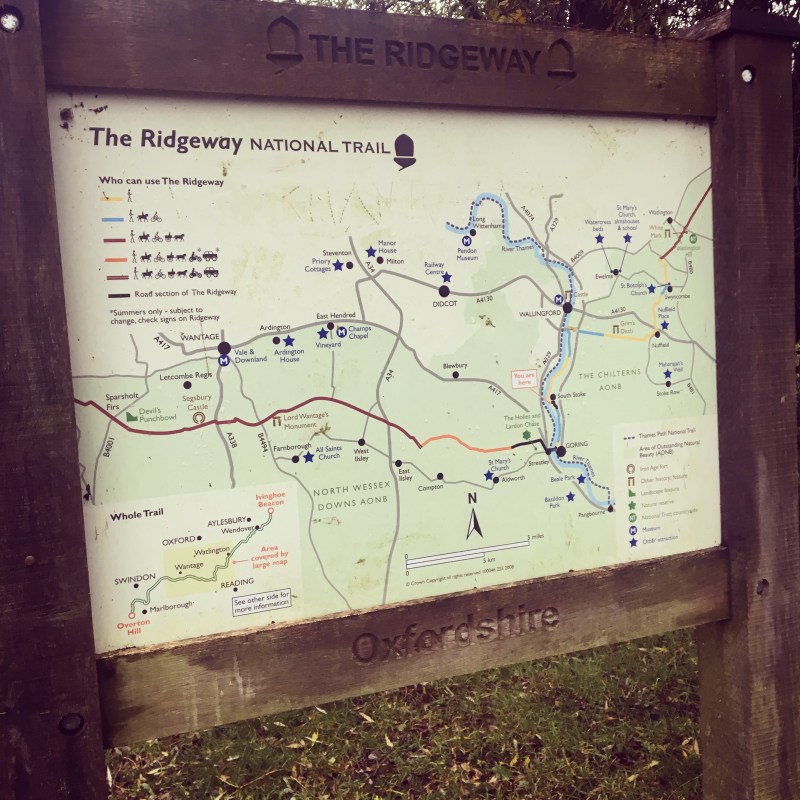
The race covers almost the entire Ridgeway National Trail over three days: 29 miles on Friday, 27 on Saturday and 28 on Sunday. I couldn’t get the time off on Friday for the first leg from Ivinghoe Beacon to the school at Watlington so I missed out on the first night’s camping as well; on the other hand it had been a big week at work and a solid night’s sleep in my own damn bed was more of a novelty than camping, so I banked it. Car packed, I drove up to my first post at checkpoint two at the crack of dawn on Saturday, ready for action.
Being a production manager by trade, I had printed out every last scrap of information I could find, calculated how long it would take me to get to the checkpoint, gave myself a good margin of error and then set off slightly earlier than that. The instructions told me I was needed at the checkpoint an hour in advance of the runner expected to pass first, and that was half past nine, so there I was, at 08:27 (including a detour for a coffee and a loo stop so as not to seem too eager). And I waited.
And I waited.
I could be relatively certain that I was in the right place – I mean it’s probably the most memorable checkpoint in the whole three days – and my satnav wasn’t disagreeing. But the checkpoint chief, Edward, was nowhere to be seen. Tussling with the fear of posting a stupid question on the group Whatsapp I tried sending messages to both Edward and to Rich the volunteer coordinator, with no luck and no signal. By half past nine I was vacillating between panic that a hundred hungry runners were about to overwhelm me and certainty that it must be me that was wrong; after all, there were at least three other people that were meant to be there and still weren’t. Just as I was about to get my trail shoes on and start running backwards along the route, wondering if the checkpoint had moved, a car drove down the muddy lane to the water’s edge that obviously had nothing to do with fishermen or dog walking.
Out of Edward’s modest estate car a whole checkpoint unfolded – I mean this is Mary Poppin’s carpet bag territory. Two fold out tables, four barrels full of water, eight or nine boxes of food and supplies (including the all-important hand sanitiser), the timing kits, the ubiquitous XNRG feather banner and various other bits of signage. Joined by fellow volunteer Laura and her son we set up as quickly as possible and started doing the clock arithmetic for when we expected the first person to pass, proving once and for all that my calculations were way out. I offered to tick off race numbers and make sure all the runners checked their wristbands against the timer, thinking at least I couldn’t get that wrong.
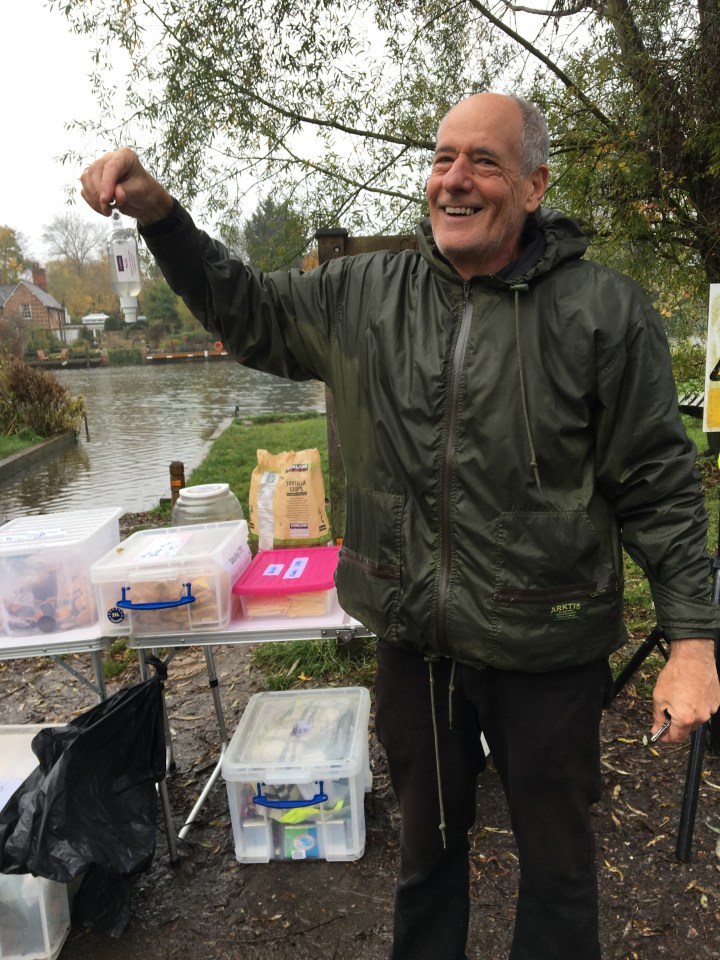
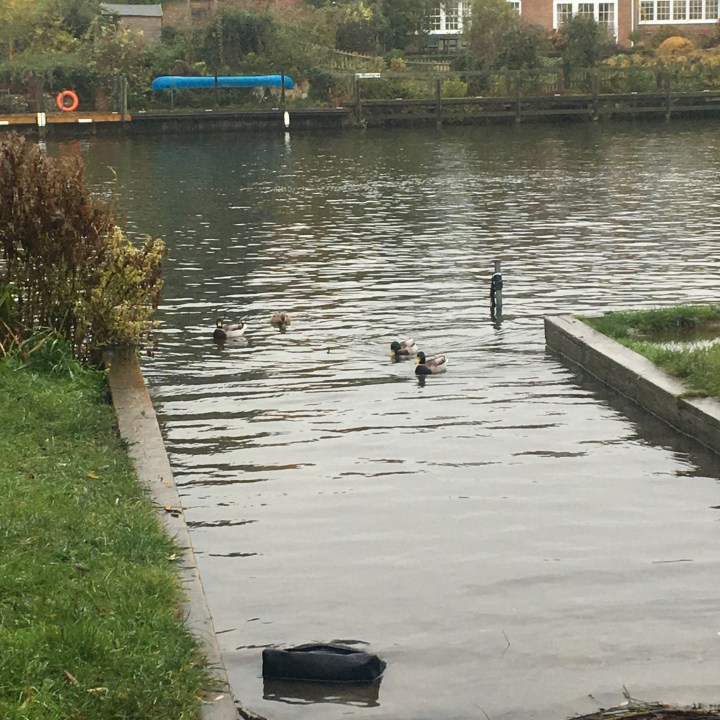
As is customary for day 2 of the Druids, especially the second stretch along the Thames, it was soggy. I tried to wipe my phone screen on my trousers to dry it off enough to use, and all that happened was that my phone screen got a different kind of wet on it. My numbers sheet actually got soaked while we were setting up and had to be laid across the car’s heating vents to dry off before we even got started; by the time we were halfway through the field I was marking fat splodges on papier mache with a mashed felt tip, literally counting down the chart to get the right number. It was like playing bingo in wet clay.
Considering the job involved standing outside in the rain without shelter for a number of hours (including the bonus ones I awarded myself) the time passed surprisingly quickly. Having to concentrate on the path and catch the runners before they took off up the road was definitely harder than being the runner concentrating on the path, something I know from previous experience on that course. I’ve given up on enough of my own races to know how annoying it is to let yourself down, but the thought of letting down another runner was really nerve-wracking. Meanwhile, a lone fisherman who was surprised to find us pitched up on the bank before him settled in at the rivers edge with his wolf (he claimed it was a dog) and patiently waited for the fish that our neon coloured, mud-thumping, giggling and panting runners were presumably scaring away. We learned an awful lot about riverside politics between rowers and kayakers, longboaters and swimmers, like a live-action version of The Wind In The Willows.
The runners came through in various states of undress and humour; most notably a first time ultrarunner who came in wearing just one shoe, having lost the other in the mud (which wasn’t surprising as they turned out to be three sizes too small for him in the first place); the man who found a neat solution to our lack of sandwiches (two jaffa cakes with a slice of cheddar in the middle); and Marie-Claude, a lady who stumbled into the aid station in a bin bag and floods of tears, having optimistically followed the weather forecast and not the basic tenet of Druids which is that day two is always wet. Bless her, she was miserable. Her waterproofs were, helpfully, in her bag back at base. Her ankles were weighed down with a pair of hand knitted leg warmers, by now waterlogged and hefty with mud, and she was pining for her sturdy walking boots. She sobbed uncontrollably as we helped her into a chair and out of the leg warmers, and Edward managed to produce both hot water and a hot chocolate sachet from nowhere. It seemed like she was destined to pull out.
Those of you that know XNRG’s multi-day challenges probably know regular face Elaine, often patiently hiking each leg in twice the time of the frontrunners and always with a smile and good humour. We knew to look out for her as the last person expected through, making Marie-Claude the second from last according to the scraps of my sheet. After a last minute bit of foot dressing by Dr Laura and the lend of a waterproof jacket, it seemed that all that Marie was short of was the will to carry on – she was in perfectly good health otherwise. We managed to convince her that if she kept going she would eventually have company from Elaine, and since there were no cut-offs she had nothing but time. To her credit as soon as she was up on her feet she got straight on with it – a lesson in the power of appropriate kit and a bit of positive thinking. We all sympathised with her low moment, but we all know those moments pass much faster than the disappointment of a DNF. Not long afterward came Elaine, as smiling and beatific as ever. We had a bit of a chat with her as she loaded up on jaffa cakes and some of Laura’s homemade flapjacks, and off went the last of our intrepid explorers.
My next shift was back at the school manning the tea and cake stand. Yeah I know, what a hardship. Handing out tea and cake to people 56 miles in to the Ridgeway is a very gratifying job anyway – I mean, nobody’s exactly turning their nose up at free cake – but to ultra geeks like me it’s also a front row seat to the best show on earth, watching the likes of Edwina Sutton and Justin Montague do what they do best and barely break sweat in the process. And because I’m my mother’s daughter I had great fun buzzing around like a busybody and forcing tea into chilly hands.
And then the hard work began.
While Susie Chan and Rory Coleman delivered their after-supper presentations, we had to clear the canteen and set up for breakfast the following morning, as well as keep the hot drinks and cake flowing and the jerrycans full of water. I sort of knew, from previous experience, that the job would involve making sure these vital things were available as long as everyone was awake, but I hadn’t quite appreciated just how much 300 runners and walkers could get through – I don’t think I stopped moving until past 11pm, an hour after lights out. Straight into event mode, I fell into my cot bed feeling wonderfully weary and stared at the ceiling for five hours, too buzzed to sleep.
My alarm went off at half 5 just as I’d started to drift off, and by the time I got to the canteen the early risers on the first wave were already tucking in. The walkers were due to start at 7am but would need to be on the shuttle bus by half 6 in order to be taken to the restart point, on the exposed top of East Hendred Down. The well-oiled machine that is XNRG splits up the runners into groups according to their finishing times from day 2, which is crucial in making sure that there are enough seats on the shuttle buses to get everyone to the top – and naturally, everyone bargains to go in the middle group. Once again I saw the wider context of my selfish runner’s needs; if 5 percent of the field ask to be the “one change” to the grouping, they’d need to hire a whole extra bus to accommodate. Considering that I’ve always felt very well looked after at XNRG’s races, I saw firsthand how it’s not abundance of resources but Anna and Neil’s military precision that fulfils our every need; at the same time, it’s clear to see how quickly what profits they do turn could be swallowed up for the want of a bit of forward planning.
By the time we’d seen all three groups breakfasted and on the buses – not to mention their luggage – I was already jumping into the car for my next job: manning station 2 at Hinton Parva, this time under the guidance of checkpoint chief Wendi. Even more wobbly than the soggy ground we set up on on Saturday, this time the table was on a thirty degree slope and the Haribo were in even more danger of flying away than of being snaffled. Following the classic Druid’s schedule, day 3 was a clear, crisp day, dry and bright but absolutely fucking freezing. FREEZING. So, almost as good weather to be standing out in for hours as incessant rain.
God it was fun though. Wendi, a stalwart of XNRG races, is like your friend’s hilarious mum who you sort of wish was your mum. We were messing around so much I only just got the signage and timing pad set up in time for the first runner through, and as the checkpoint is at the bottom of a long downward slope they were barrelling past us – I had to move up the hill to allow for reaction time, they were that fast. As was to be expected the field was more stretched out than yesterday, and by the time we got halfway through my toes (even in their two pairs of socks and thick boots) were already blocks of ice, and my writing basic caveman smudges through my heavy duty gloves.
There was an addition to the timing system this year: a tracker held by the runner at the back of the field which, in the absence of cutoffs, allowed us to see roughly how long we should stay open, avoiding the risk of closing up too early or hanging around for ages unnecessarily. It’s a fairly low tech system which relies on the last runner handing it to whomever they overtake; on the other hand, the tracker had been in the reliable hands of Elaine for days 1 and 2 so we weren’t too worried about losing it. In fact, we learned over the wireless (Whatsapp) that Elaine had company for the day: Marie-Claude, the girl who looked like she wasn’t going to drop out so much as drop dead the day before, had swapped her trail shoes for her hiking boots and every layer of clothing she had, and joined Elaine to enjoy the rest of the Ridgeway at a leisurely pace.
The third day had really started to take its toll on people, and there were at least three dropouts at our station – injured knees and swollen feet scattered around the trail like the aftermath of a battlefield. As I ticked off each race number, either as they passed or were reported on Whatsapp as a dropout from checkpoint one, my runner bingo card became a tally of the most weary, pained and battered people I’d ever seen. Eventually we were down to a group of four colleagues who were hiking together, who passed through smiling as benignly as if they were on a Sunday stroll – actually I almost mistook them for dogwalkers, they were so laid back – and shortly afterwards, the cheerful grins of Marie-Claude and Elaine. I’ve often commented on Elaine’s particular brand of good-natured, matronly stamina, but together they were giggling like schoolgirls who’d snuck away from double Physics. In fact, they were having so much fun that their pace had increased fairly drastically since the first leg – drastically enough that their second wind later turned out to be enough to overtake the Sunday strollers. That’s the final ingredient in a successful ultramarathon – a pinch of childish fun. Because how else do you forget about the lows?
Having seen them safely off we packed up, and I drove back to base to clock my final shift of the weekend: being the Mrs Overall of HQ once again. I feel like I might have been given a slightly charmed rota since all I seemed to do was chat to runners and serve them coffee; but I reflected later than perhaps my impression of volunteering at a race involved a lot more hardship than I thought it would. Don’t get me wrong, it was still ten times tougher than running the bloody thing – and if I’ve heard a single piece of advice about ultras I feel qualified to pass on it’s that you should always smile at the checkpoint volunteers – but it was worth it to appreciate just how much effort goes into this very very complex operation designed to give a small bunch of nutters a good time. And it’s the tip of the iceberg – I turned up on the day and followed a rota and did what I was told. My professional experience tells me that months of preparation and negotiation went into getting the race permit and selling the places, securing the stopover venues, working out and then booking the logistics, sorting out the food and drink supplies, assembling and organising the volunteer team, reorganising them when people pulled out at late notice – never mind the details.
Only when I started for home, very nearly suppertime and all I’d eaten was thieved Haribo and cake, did I start to dive off the crest of adrenalin I’d been surfing all weekend. My lack of fitness and training sent me into a downward spiral at the beginning of this year that became so bad I couldn’t even bear to look at my running club’s social media posts, I was in such a grimy well of self pity. The idea of volunteering to keep in touch when you can’t run always seemed like a good one on paper, but I just couldn’t bear watching other people do the things I wanted to be doing; like watching the ex that broke your heart in a shiny new relationship. Druids was the one event that I felt would be worse to miss altogether than to be involved with in some way, and I’m so glad I got stuck in. It might not have been an entirely altruistic gesture, offering to volunteer just to cheer myself up, but I hope at least it was a mutually beneficial act. Like sharing a smile at the aid station, a good deed – however selfish the motive – cannot help but spread goodwill.
Still though… my Pilgrim’s entry went in the very next day. I’m gonna earn my cake this time.